Learn › Probability of an Event Not Happening
Probability of an Event Not Happening
How to find the probability that something does not happen, with two worked examples.
How it works
Something either happens or it does not, so the two probabilities add up to 1 (certain). That means the probability it does not happen is 1 take away the probability it does.
This works the same with decimals and with fractions: with fractions, think of 1 as a whole, such as 12/12.
Worked examples
1. Rain tomorrow is 0.3: the probability it does not rain
The probability that it will rain tomorrow is 0.3.
Work out the probability that it will not rain tomorrow.
- It either rains or it does not, so the two probabilities add up to 1.
- 1 − 0.3 = 0.7.
- The probability it does not rain is 0.7.
2. Sam wins with probability 1/12: the probability Sam does not win
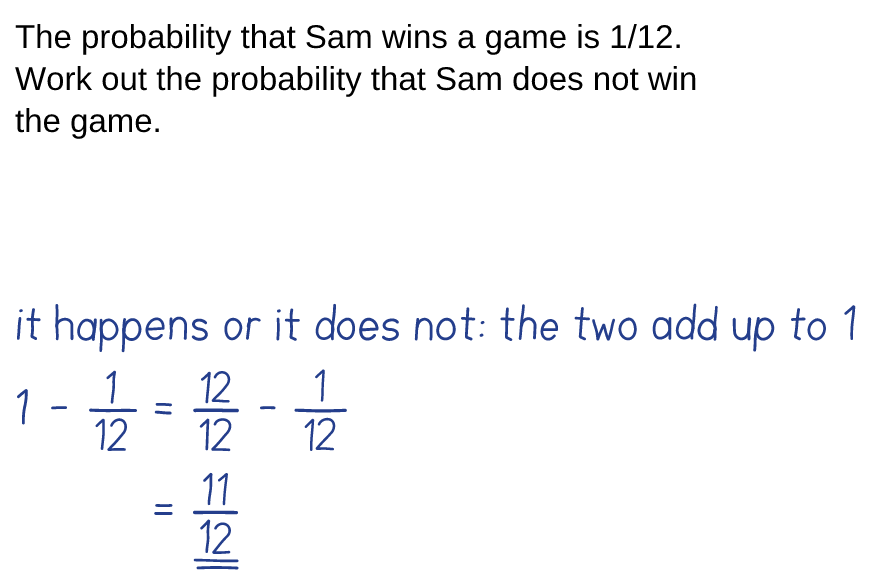
- Write 1 as twelfths: 1 = 12/12.
- 12/12 − 1/12 = 11/12.
- The probability Sam does not win is 11/12.
The common mistake
Taking away from 100 or 10 instead of 1. Probabilities run from 0 to 1, so 1 − 0.3 is 0.7, not 99.7 or 9.7.
Practise this topic on printed sheets that mark themselves.
Start practisingSuggest an improvement
Something unclear, or a better way to explain it? Tell us and we will improve this page.