Learn › Prime Numbers
Prime Numbers
What makes a number prime and how to test one, with two worked examples.
How it works
A prime number has exactly two factors: 1 and itself. So 7 is prime (only 1 × 7), but 15 is not (it is also 3 × 5). 1 is not prime, because it has only one factor.
To test a number under 100, try dividing it by 2, 3, 5 and 7. If none of them divides it exactly, it is prime. A quick test for 3: add the digits, and if the total divides by 3, so does the number.
Worked examples
1. Which of 15, 21, 35, 43, 51 is prime?
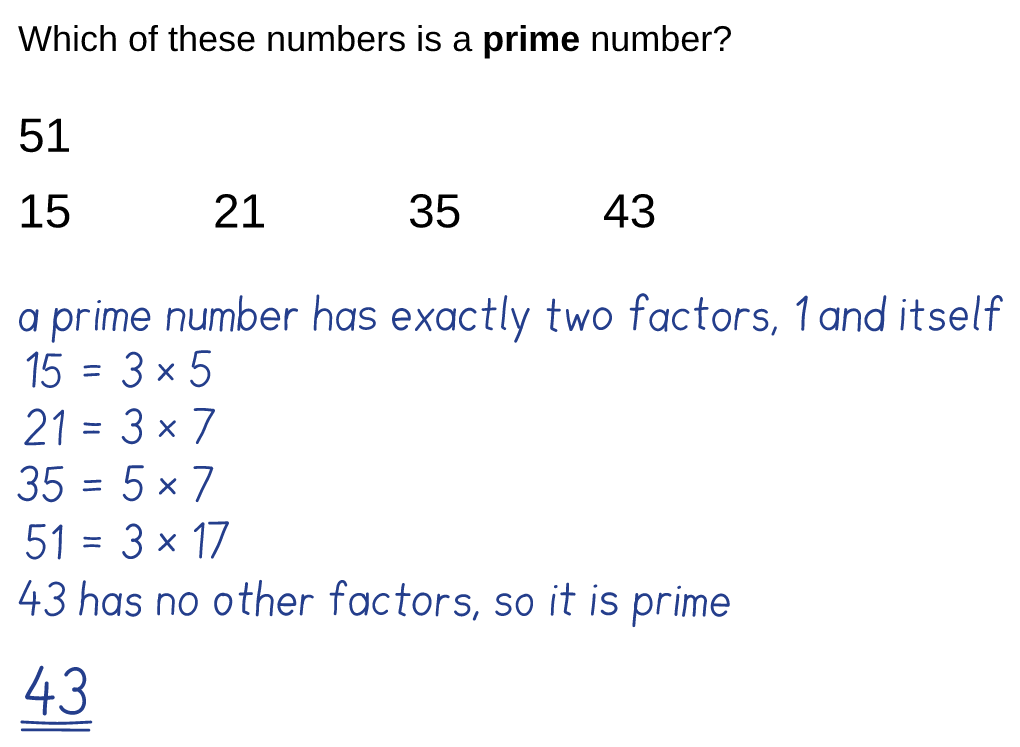
- 15 = 3 × 5, 21 = 3 × 7 and 35 = 5 × 7, so none of them is prime.
- 51: its digits add to 6, which divides by 3, so 51 = 3 × 17. Not prime.
- 43 does not divide by 2, 3, 5 or 7, so 43 is the prime.
2. Which of 27, 37, 39, 45, 57 is prime?
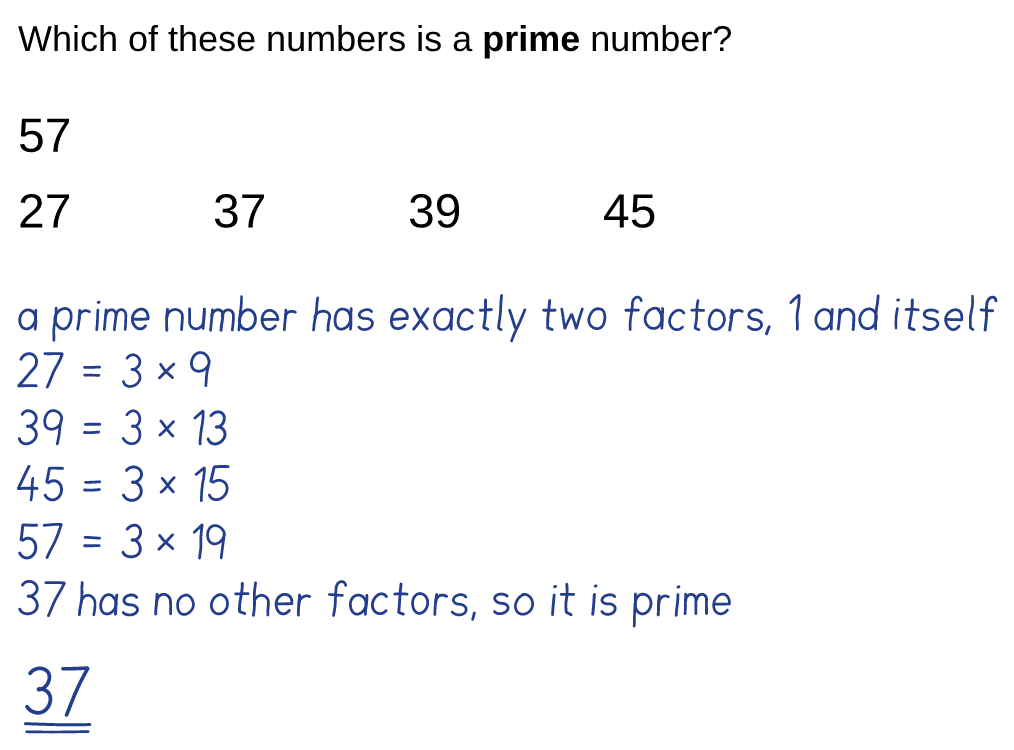
- 27 = 3 × 9 and 45 = 5 × 9.
- 39 and 57 both have digits adding to a multiple of 3: 39 = 3 × 13 and 57 = 3 × 19.
- 37 does not divide by 2, 3, 5 or 7, so 37 is the prime.
The common mistake
Thinking every odd number is prime. Numbers like 51 and 57 look prime, but both divide by 3. Always try 3 and 7 before deciding.
Practise this topic on printed sheets that mark themselves.
Start practisingSuggest an improvement
Something unclear, or a better way to explain it? Tell us and we will improve this page.