Learn › Ordering Decimals of Different Lengths
Ordering Decimals of Different Lengths
How to put decimals with different numbers of places in order, with two worked examples.
How it works
To compare decimals, line them up by their decimal points and compare digit by digit from the left: whole numbers first, then tenths, then hundredths, then thousandths.
A quick way to do this is to give every number the same number of decimal places by adding zeros on the end. 0.7 becomes 0.700, which does not change its value but makes it easy to compare with 0.709.
Worked examples
1. 0.741, 0.8, 0.7, 0.73, 0.709
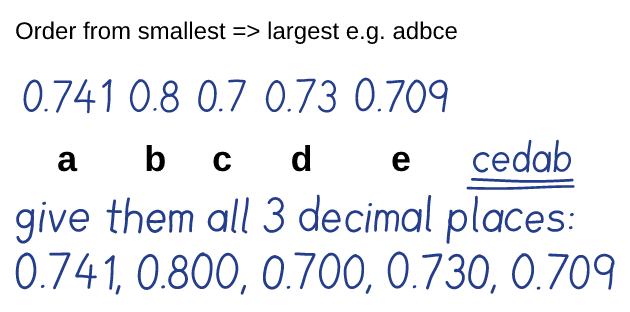
- Fill with zeros to three places: a 0.741, b 0.800, c 0.700, d 0.730, e 0.709.
- Compare them as whole numbers of thousandths: 700, 709, 730, 741, 800.
- Smallest to largest: c, e, d, a, b, so the answer is cedab.
2. 0.3, 0.2, 0.07, 0.22, 0.25
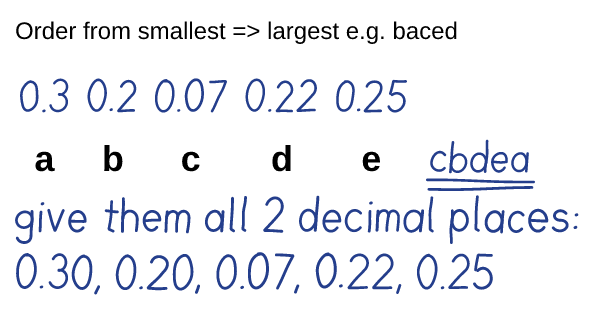
- Fill with zeros to two places: a 0.30, b 0.20, c 0.07, d 0.22, e 0.25.
- In hundredths: 30, 20, 7, 22, 25.
- Smallest to largest: c, b, d, e, a, so the answer is cbdea.
The common mistake
Thinking a longer decimal is bigger. 0.709 has more digits than 0.8, but 0.8 is bigger: compare the tenths first, and 8 tenths beats 7 tenths whatever comes after.
Practise this topic on printed sheets that mark themselves.
Start practisingSuggest an improvement
Something unclear, or a better way to explain it? Tell us and we will improve this page.