Learn › Fractions of Amounts
Fractions of Amounts
How to find a fraction of an amount, and why it works, with two worked examples.
How it works
The denominator is what you are dividing by. Multiplication by ¼ is the same as division by 4.
The bottom number of a fraction (the denominator) says how many equal parts the amount is split into. The top number (the numerator) says how many of those parts you take.
So to find a fraction of an amount: divide by the bottom number to find one part, then multiply by the top number. "Of" means multiply, which is why the sheet writes it as ×.
Worked examples
1. ¼ × 128
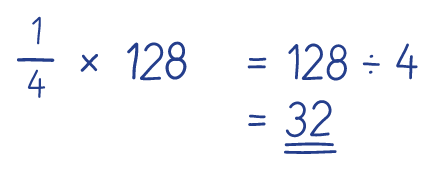
- The bottom number is 4: split 128 into 4 equal parts. 128 ÷ 4 = 32.
- The top number is 1: take one part.
- The answer is 32.
2. 7/12 × 168
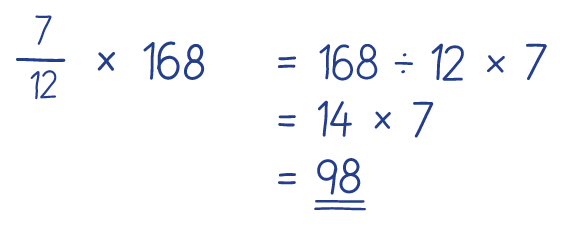
- The bottom number is 12: one twelfth of 168 is 168 ÷ 12 = 14.
- The top number is 7: take seven of those parts. 14 × 7 = 98.
- Check: 7/12 is just over a half, and 98 is just over half of 168.
The common mistake
Dividing by the top number and multiplying by the bottom: 168 ÷ 7 × 12 = 288, which is more than 168. A fraction less than one always gives an answer smaller than the amount, so an answer that is bigger has the numbers the wrong way round.
Practise this topic on printed sheets that mark themselves.
Start practisingSuggest an improvement
Something unclear, or a better way to explain it? Tell us and we will improve this page.