Learn › Decimals to Fractions
Decimals to Fractions
How to write a decimal as a fraction in its simplest form, with two worked examples.
How it works
The last decimal place tells you the bottom number of the fraction. One decimal place means tenths (over 10), two means hundredths (over 100), three means thousandths (over 1000).
So write the digits after the point over 10, 100 or 1000, then simplify: divide the top and bottom by the same number until nothing more divides both.
Worked examples
1. 0.75
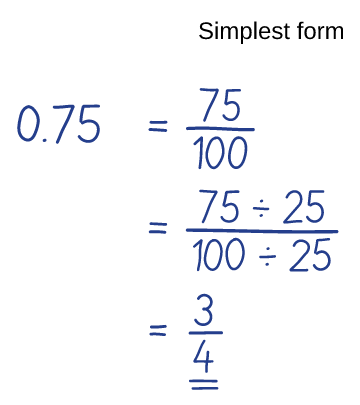
- Two decimal places, so it is 75 hundredths: 75/100.
- 25 divides both: 75 ÷ 25 = 3 and 100 ÷ 25 = 4.
- The simplest form is 3/4.
2. 0.12
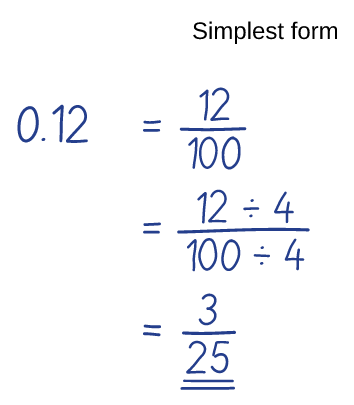
- Two decimal places, so it is 12/100.
- 4 divides both: 12 ÷ 4 = 3 and 100 ÷ 4 = 25.
- Nothing else divides 3 and 25, so the answer is 3/25.
The common mistake
Stopping before the fraction is in its simplest form. 75/100 is equal to 0.75, but the sheet asks for the simplest form, 3/4. Always check whether one number divides both the top and the bottom.
Practise this topic on printed sheets that mark themselves.
Start practisingSuggest an improvement
Something unclear, or a better way to explain it? Tell us and we will improve this page.